

by
Josh Claman
Every unveiling of future GPUs is further evidence that liquid cooling adoption is—in fact, has been—an inevitability. While single-phase direct-to-chip (1P D2C) may be perceived as the incumbent solution on the market, its maintenance demands and dwindling runway have left many data center operators wondering what’s next on the horizon.
We are what’s next. The entirety of our fast-growing pipeline and order book is compiled of clients who have closely compared 1P D2C and our NeuCool® two-phase D2C technology and determined us the victor. The reasons are comprehensive but clear: lower power requirements, lower flow rate requirements, higher FWS temperatures for higher TCO savings, and the ability to protect investments over several generations of processors by sheer fact of our superior thermal performance—to name a few. Simply put, the demand for our solution is stronger than ever.
Transitioning from single-phase to two-phase for our partners involves integrating two-phase cold plate assemblies onto their servers. If the server is cooled by water, we simply swap their internal assemblies to those designed for our refrigerant-based cooling. Our customer base finds this process yields substantial dividends: either experiencing our competitive differentiators firsthand, or preventing water-based leaks from destroying millions’ worth of critical hardware—or, of course, both.
Imagine, however, if we did away with swapping out assemblies altogether—and instead redefined customer choice within our vendor ecosystem. You could accomplish all this with a single word: universality.
Universal Cooling Is Closer Than You Think
Universality—redesigning server architecture to render it cooling-agnostic—involves minor changes at most.
To date, server OEMs have prioritized plumbing liquid-cooled server SKUs for water alone. Accommodating refrigerants requires only easy tweaks: namely, those meant to minimize pressure drops and enable elastomer compatibility (in components like o-rings, gaskets, etc.) for both water and refrigerants.
Similarly easy tweaks are required for cold plates. Multiple studies presented by our engineering team at Thermal Conferences and OCP have proven our ability to enhance cold plates for NeuCool to handle hot spots and heat fluxes way ahead of today’s processors or accelerators. Today’s cold plates have also made strides to withstand single- and two-phase’s respective pressure thresholds—mostly due to single-phase’s attempts to extend its limited runway.
1P D2C’s inability to undergo phase change results in a lower performance threshold compared to 2P D2C’s latent heat absorption. To compensate, 1P D2C has drastically raised its flow rates—and has redesigned its cold plates to withstand pumping water through its microchannels with the force of a fire hose. Largely, this means brazing and its equivalents (such as stack forging and additive manufacturing).
The widespread introduction of brazed and additive techniques to single-phase cold plates has effectively raised the standard pressure containment threshold to 200+ psi. This expansion of acceptable cold plate pressures now includes the territory in which two-phase fluids ideally operate. Said differently, single-phase has improved its cold plate mechanical structure to be robust enough for two-phase refrigerants; and, in doing so, has driven customers closer to adopting cold plates that can accommodate either cooling solution.
However, in a “control” scenario where cold plates are considered truly universal, the question must be asked: which solution exhibits supreme performance? The answer (of course) is two-phase.
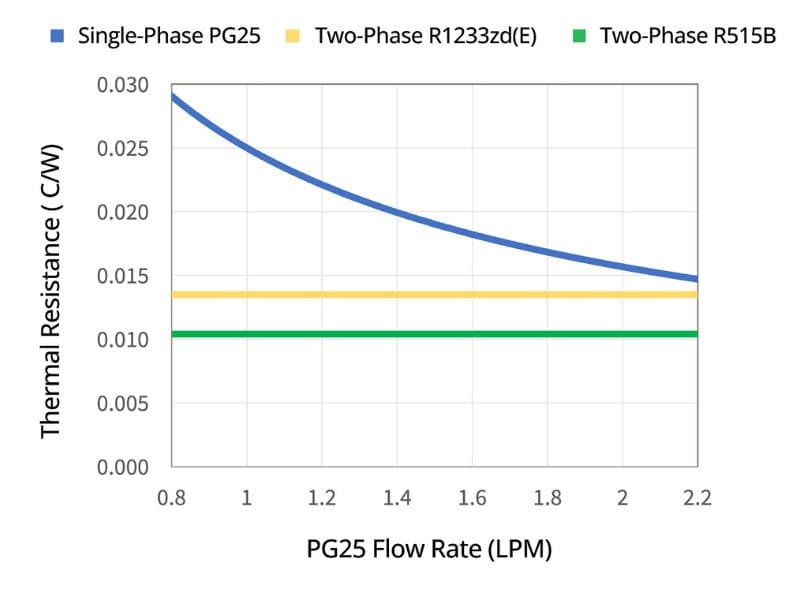
A dedicated study published and presented at OCP has demonstrated not only the feasibility of a universal cold plate, but also that “two-phase cooling performance was demonstrated to be better than single-phase at representative conditions, even when utilizing a cold plate optimized for single-phase cooling.” Conducted in 2024, the study concluded that a universal cold plate could ease the transition from 1P to 2P D2C cooling in the next two to five years—which means, in 2026, that the time for universal cold plate adoption has arrived.
Ending The Era of Cooling-Specific Servers
Imagine a world in which universality was an achievable standard—a world that exists only a few minor steps from our own. In that world, a Dell or SMC liquid-cooled server could be connected to either a single- or two-phase CDU, enabling the ultimate in customer choice. This world would, of course, also enable minimal SKU complexity, lower costs, and high-quality integrations for server OEMs. No longer would customer and vendor alike be plagued by questions of integration risks, procurement constraints, needless complexity, and supply chain fragmentation.
With all this in mind, only one question remains: why not?